5 Signals Your Revenue System Is Breaking
Revenue teams are entering 2026 with confidence, but not execution.
For example, 69% of salespeople believe their organization is well equipped to handle future market changes. Yet, 90% have encountered at least one major obstacle to hitting their targets.
That gap isn’t about talent or strategy. It’s a breakdown in how work actually gets done. And at scale, those breakdowns point to the system behind it.
The pressure to operate efficiently has never been higher. Last year, 41% of compensation professionals said improving operational efficiency was a top objective, and 61% of compensation teams measured ROI using sales efficiency metrics like deal velocity and win rates. At the executive level, 43% of CEOs cite optimizing operations and improving productivity as a top priority as transformation efforts accelerate into 2026.
But the day-to-day reality tells a different story, including manual commission tracking, delayed quotas, misaligned metrics, and payout errors. These aren’t edge cases. They’re how many revenue teams still operate, introducing friction that slows performance, distorts incentives, and creates constant drag on results.
CaptivateIQ’s 2026 State of Sales Report puts a name to this disconnect: It’s the confidence gap.
The confidence gap is the difference between feeling prepared and being able to perform. Here are five signals your revenue system is breaking, and how to fix them to keep your revenue engine running efficiently.
Signal #1: Reps self-audit commissions in spreadsheets
When reps can’t clearly see or understand how they’re paid, they validate the results themselves.
In fact, 76% of sales reps wish there were more transparency in how their compensation is calculated. And only 52% of companies say they provide real-time performance tracking.
So reps fill the gap. They track deals in spreadsheets. Recalculate payouts. Double-check every commission statement.
It adds up quickly. Salespeople spend an average of 1.6 hours per week validating their own commission math. On a 500-person team, that’s the equivalent of 20 full-time employees focused on auditing pay instead of selling.
This isn’t just inefficiency. It’s a breakdown in trust and a direct hit to productivity.
How to reduce shadow accounting
Eliminating shadow accounting starts with visibility and confidence. RevOps leaders need to:
- Provide real-time earnings visibility. Reps should always know where they stand against quota and what they’ve earned. Consider ICM software that consolidates data and automatically calculates earnings in real time.
- Make compensation logic transparent. Break down how payouts are calculated in a way reps can understand and trust. If they can’t explain it, they won’t believe it.
- Create a single source of truth. Replace offline tracking with centralized, system-driven reporting that updates automatically.
Signal #2: Managers field frequent comp questions
When compensation isn’t clear or easily accessible, questions escalate. It’s no wonder 35% of companies say lack of transparency into compensation is a top challenge. And, only 50% give reps visibility into current and potential earnings.
The result? Managers become comp help desks, spending time answering questions instead of driving meaningful results. In fact, nearly 80% of teams receive more than 10 rep inquiries per pay period, with some fielding more than 50 every cycle.
How to reduce compensation queries
The goal isn’t faster responses. It’s fewer questions.
- Give reps self-service access to answers. Reps should be able to see performance, earnings, and payout details without going through a manager.
- Standardize and document compensation logic. Clear rules reduce ambiguity — and eliminate repeat questions.
- Centralize communication and visibility. Avoid scattered answers across Slack, email, and spreadsheets. Create one place reps can go for accurate, up-to-date information.
- Design for clarity, not just accuracy. A plan can be technically correct and still confusing. If reps don’t understand it, they’ll keep asking about it.
Signal #3: Quotas arrive too late to achieve
You can’t hit a target you don’t have. Yet, 71% of salespeople start the year without a quota.
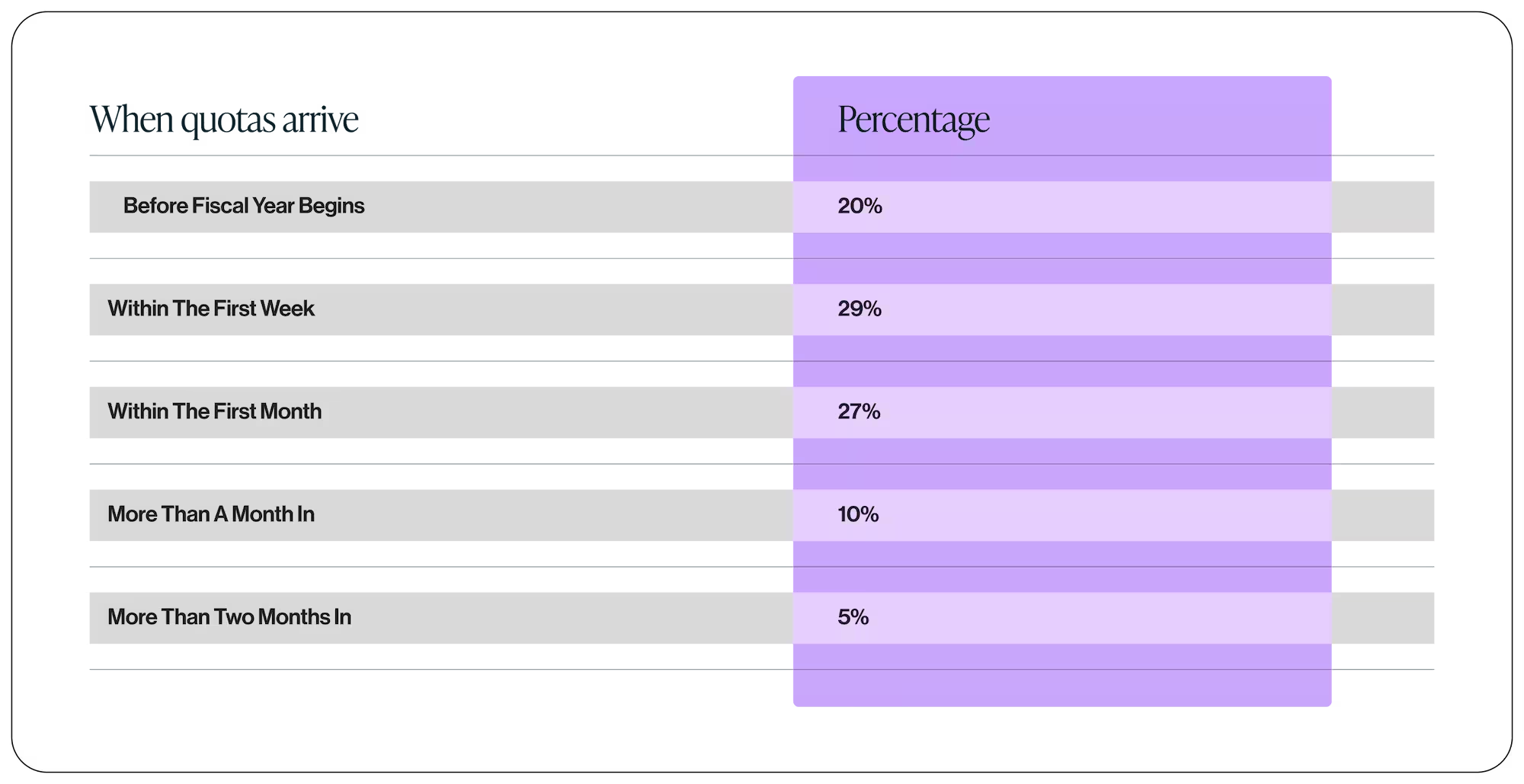
That delay doesn’t just push planning timelines. It reduces the amount of time reps actually have to generate revenue.
Selling capacity isn’t unlimited. When quotas arrive well into the year, the effective selling window shrinks. Reps spend that time guessing at priorities, hedging on deals, or waiting for clarity instead of executing against a defined target.
And that lost time doesn’t come back. It compresses performance into a shorter window, making quotas harder to hit and forecasts less reliable.
There’s also a trust cost. Late quotas rarely happen in isolation. They’re often paired with limited communication, shifting targets, and unclear expectations. Reps don’t just lack direction. They lose confidence in how the business is operating.
Instead of starting the year aligned, teams start behind and spend the rest of the year trying to catch up.
How to accelerate quota readiness
The goal isn’t just to set quotas. It’s to operationalize them early enough to matter.
- Finalize quotas before the fiscal year starts. Day one clarity drives day one performance. Delays create drag that compounds over the year. Get our recommended sales planning timeline in CaptivateIQ’s Guide to Sales & Incentive Planning to ensure your quotas are ready before the new fiscal year begins.
- Connect planning systems to execution systems. Quotas shouldn’t live in static spreadsheets. They should flow directly into the systems reps use to track performance.
- Reduce dependency on manual processes. The more steps required to model, approve, and distribute quotas, the more likely they are to arrive late.
- Enable scenario planning without slowing rollout. Teams should be able to model changes without delaying initial quota delivery.
Signal #4: Activity metrics replace outcome metrics
What you measure is what gets optimized.
Only 58% of compensation leaders track revenue growth tied directly to incentives. That means 42% lack a clear line of sight into whether their plans are actually driving results.
In that gap, teams default to what’s easy to measure.
For example, 11% of salespeople are still measured on activity-based metrics, such as calls made, emails sent, and meetings booked, instead of outcomes like revenue, deal progression, or win rates.
That shift changes behavior. Reps optimize for activity volume instead of impact. But those activities don’t necessarily move deals forward. The result is false productivity.
Pipeline fills with low-quality opportunities. Conversion rates decline. Managers see effort, but lack a clear view into what’s actually driving revenue.
Over time, performance drifts further from the outcomes the business is trying to achieve.
How to refocus on outcomes
The goal isn’t to track more metrics. It’s to track the right ones.
- Tie incentives directly to revenue outcomes. Compensation should reinforce what the business actually cares about, including metrics like closed revenue, deal quality, and progression.
- Use activity metrics as diagnostics, not goals. Activities can signal effort, but they shouldn’t define success.
- Measure efficiency, not just volume. Track metrics like win rates, deal velocity, and pipeline conversion to understand what’s working.
Signal #5: Payout errors are treated as normal
A whopping 77% of salespeople have experienced payout errors. And 66% of companies have overpaid or underpaid commissions.
As a result, 34% of compensation leaders say fixing calculation errors caused by manual processes is a top challenge.
The impact shows up immediately. Every error triggers a chain reaction. Reps flag discrepancies, managers get pulled in, and RevOps teams investigate and recalculate payouts. Instead of focusing on planning and performance, teams are stuck fixing issues after the fact.
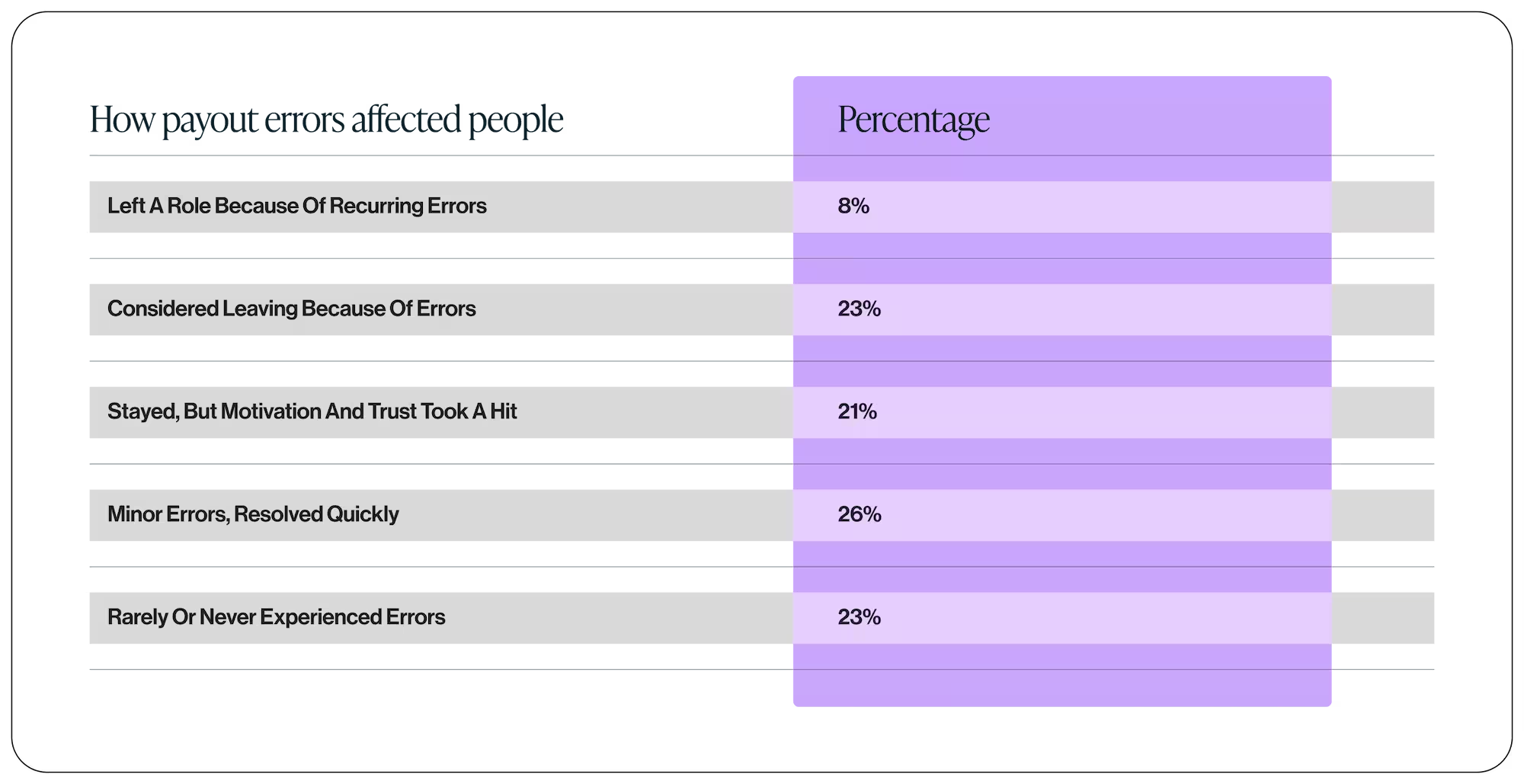
But the bigger cost is trust.
When payouts are inconsistent, reps stop relying on the system. They double-check every commission statement, question every discrepancy, and spend time validating earnings instead of selling.
And once that trust is lost, it’s hard to rebuild.
Even when errors are corrected, the behavior remains. What starts as a calculation issue quickly becomes a performance issue.
How to reduce payout risk
The goal isn’t to fix errors faster. It’s to prevent them.
- Eliminate manual calculations. Spreadsheets and disconnected systems introduce risk at every step. Automate calculations wherever possible.
- Standardize data inputs and validation. Inconsistent or incomplete data is one of the biggest drivers of payout errors.
- Create auditability within the system. Every payout should be traceable, explainable, and easy to verify without manual investigation.
- Test plans before they go live. Model edge cases and run validation scenarios to catch issues early.
Fix the friction to unlock revenue
Revenue performance doesn’t break all at once. It erodes through signals like these. The teams that outperform aren’t immune. Instead, they catch and correct these issues early.
Download CaptivateIQ’s 2026 State of Sales Report to see where your revenue system stands and what to fix next.
Lorem ipsum dolor sit amet, consectetur adipiscing elit. Suspendisse varius enim in eros elementum tristique. Duis cursus, mi quis viverra ornare, eros dolor interdum nulla, ut commodo diam libero vitae erat. Aenean faucibus nibh et justo cursus id rutrum lorem imperdiet. Nunc ut sem vitae risus tristique posuere.
